Stationery Bill Format: Free Excel, Word & PDF Templates
 Bill Generator Team
What is a stationery bill?
A stationery bill records a genuine sale of items such as notebooks, pens, paper, files and other office or school supplies. A GST-registered seller issuing a tax invoice should identify the seller and buyer where required and list each item with its description, quantity, rate, applicable HSN classification and GST treatment.
Stationery items do not all have the same GST rate. From 22 September 2025, several basic learning materials became Nil-rated, while products such as pens, ordinary copier paper, registers and many file products remain taxable.
Download stationery bill templates
- Excel invoice calculator (.xlsx)
- Editable Word template (.docx)
- Filled sample PDF — SAMPLE / DEMO (.pdf)
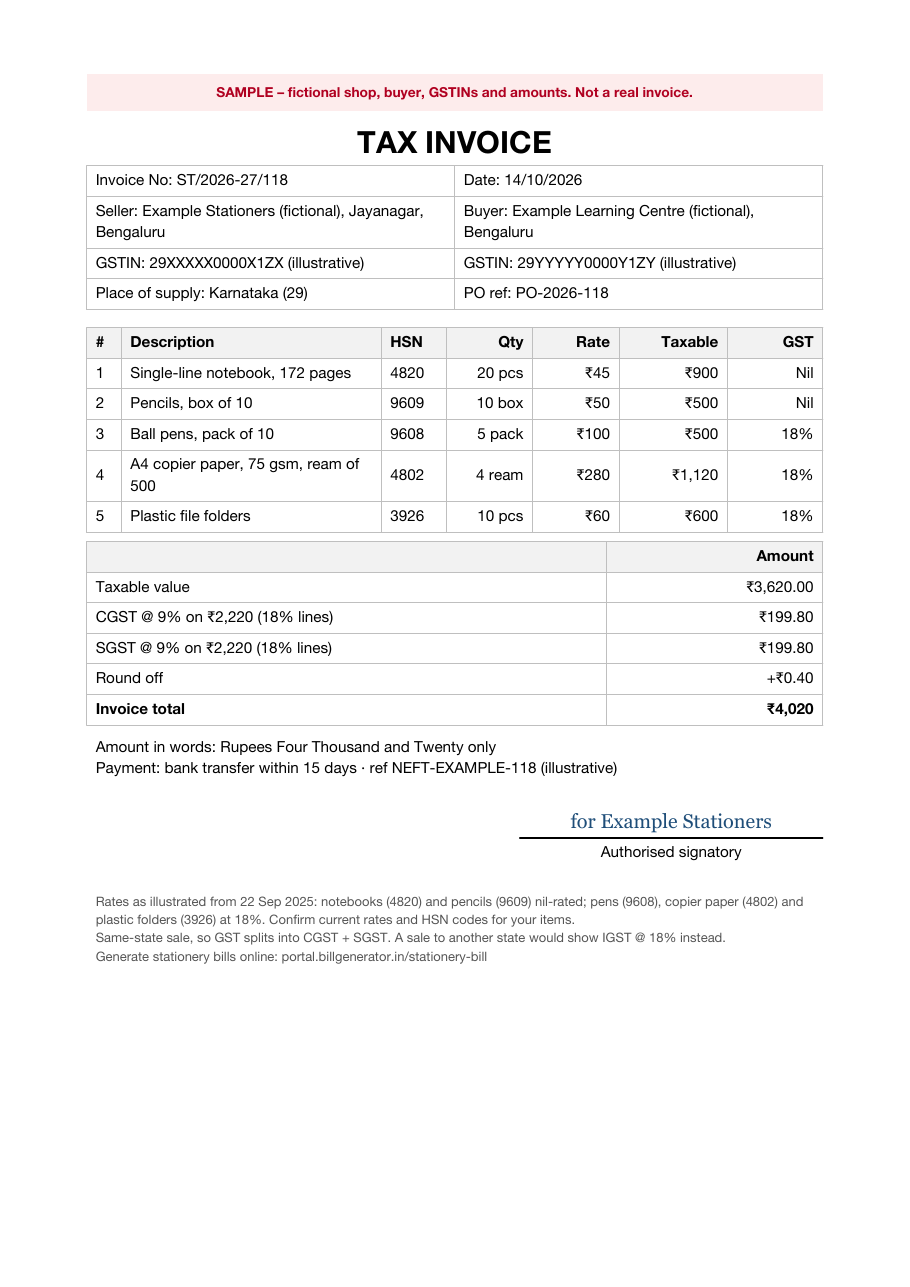
The filled PDF and image use a fictional shop, buyer and GSTINs and should be visibly marked SAMPLE / DEMO — NOT VALID FOR CLAIMS.
What a stationery bill should include
Rule 46 of the CGST Rules sets out the particulars required on a GST tax invoice. The fields that apply depend on the seller, buyer and transaction.
Seller and buyer
- Seller's genuine name, address and GSTIN
- A consecutive invoice serial number, unique for the financial year, within the Rule 46 numbering requirements
- Invoice date
- Buyer's name, address and GSTIN where the recipient is registered
- Place-of-supply details where required, particularly for an inter-State supply
- Purchase-order reference where the buyer uses one
Items
- Description of each item
- Applicable HSN code
- Quantity and unit where applicable
- Unit rate and discount
- Value of the supply
- Applicable GST rate for each taxable line
Totals
- Value of Nil-rated/exempt and taxable supplies shown clearly
- CGST and SGST, or IGST, as applicable to the transaction
- Round-off and invoice total
- Signature or digital authentication where applicable
Field-by-field
| Field | What to enter | Why it matters |
|---|---|---|
| Invoice number | Genuine consecutive invoice reference | Identifies the transaction and supports invoice records |
| Seller GSTIN | Seller's own GSTIN, if registered | Identifies the registered supplier |
| Buyer GSTIN | Recipient's GSTIN where applicable | Supports a proper B2B tax invoice |
| HSN code | Classification applicable to the actual item | Helps determine its GST treatment |
| Quantity and unit | Pieces, packs, reams or boxes actually supplied | Shows what was sold |
| GST rate | Current rate applicable to that item | Different stationery products can have different rates |
| Place of supply | Place/state determined under GST rules where required | Helps determine intra-State or inter-State tax treatment |
| PO reference | Buyer's purchase-order number, where applicable | Helps organisations reconcile purchases |
Stationery bill format example
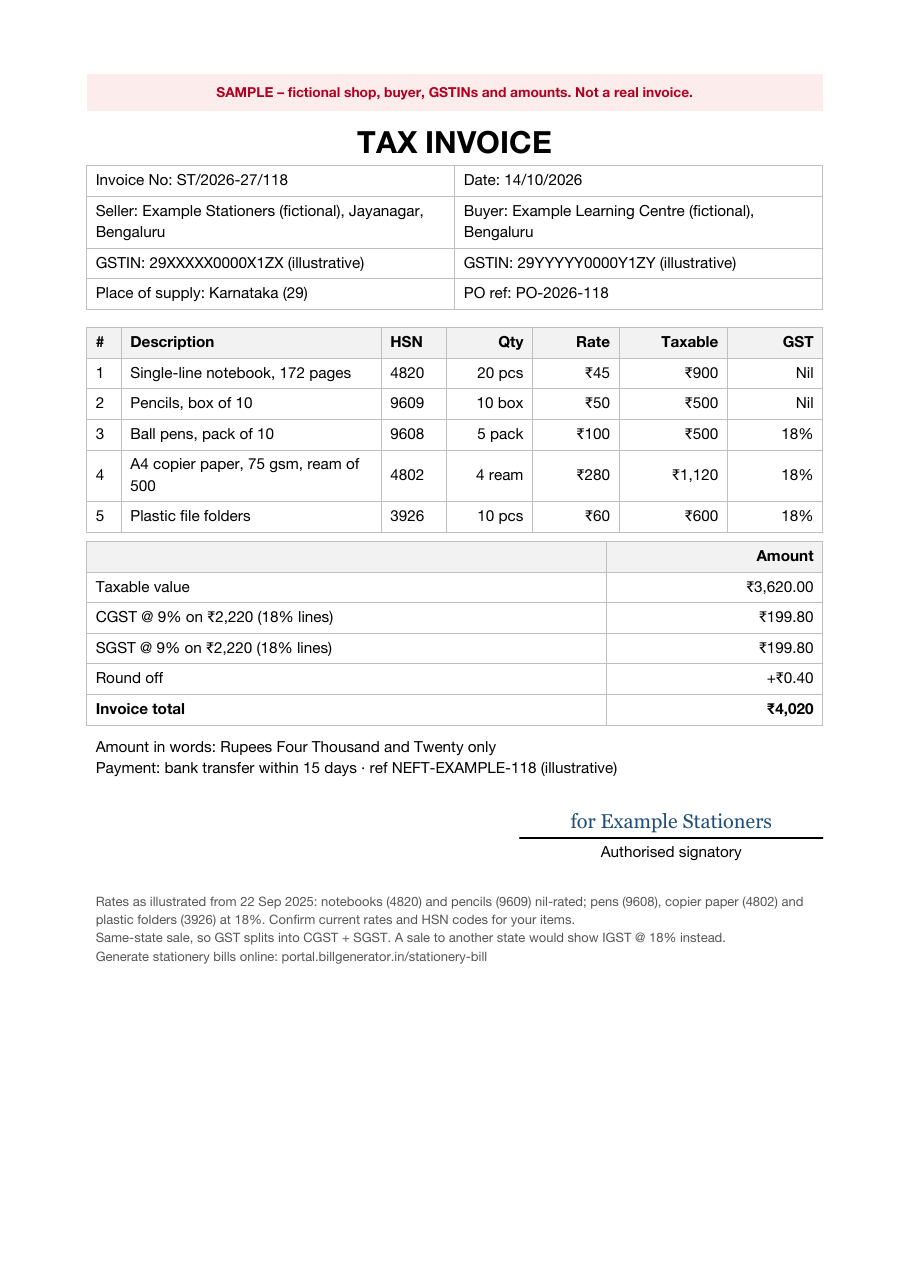
Consider a fictional intra-State sale from a GST-registered Bengaluru stationery shop to a learning centre. Prices below are before GST.
| Item | HSN | Qty | Rate | Value | GST |
|---|---|---|---|---|---|
| Single-line notebook, 172 pages | 4820 | 20 | ₹45 | ₹900 | Nil |
| Pencils, box of 10 | 9609 | 10 | ₹50 | ₹500 | Nil |
| Ball pens, pack of 10 | 9608 | 5 | ₹100 | ₹500 | 18% |
| A4 copier paper, ream of 500 | 4802 | 4 | ₹280 | ₹1,120 | 18% |
| Plastic file folders | 3926 | 10 | ₹60 | ₹600 | 18% |
| Subtotal before GST | ₹3,620 | ||||
| Value taxable at 18% | ₹2,220 | ||||
| CGST @ 9% on ₹2,220 | ₹199.80 | ||||
| SGST @ 9% on ₹2,220 | ₹199.80 | ||||
| Round off | +₹0.40 | ||||
| Invoice total | ₹4,020 |
The ₹900 notebook and ₹500 pencil lines are Nil-rated in this example, so GST is calculated only on ₹2,220 of taxable items. For an otherwise identical inter-State supply taxable at 18%, the ₹399.60 tax would generally be shown as IGST rather than CGST and SGST.
Classification depends on the exact product. All shop names, buyer details, GSTINs and invoice references in the downloadable sample are fictional.
Download the stationery bill template
The Excel invoice calculator is useful when one invoice contains items with different GST rates. Enter each genuine item's description, HSN classification, quantity, rate and applicable GST rate. It calculates line values and invoice totals and can separate intra-State CGST/SGST from inter-State IGST where configured correctly.
The Word template provides a blank A4 invoice with seller, buyer, item, tax and authentication fields for manual completion.
The filled sample PDF shows the fictional example above. All three files download without signing in.
Confirm the classification and current rate for every actual product rather than relying on the sample defaults.
GST rates and HSN codes for stationery
The GST reforms effective from 22 September 2025 changed the treatment of several common education and stationery products. The Finance Ministry specifically confirmed that pencils, pencil sharpeners, crayons, exercise books, graph books and similar learning materials moved from 12% to Nil, while erasers moved from 5% to Nil. See the Finance Ministry's summary of the 56th GST Council recommendations.
Under Notification No. 9/2025-Central Tax (Rate) and Notification No. 10/2025-Central Tax (Rate), common examples include:
| Item | Typical HSN | GST from 22 Sep 2025 |
|---|---|---|
| Exercise books, notebooks, graph books and laboratory notebooks | 4820 | Nil |
| Pencils, crayons and pastels | 9609 | Nil |
| Erasers | 4016 | Nil |
| Pencil sharpeners | 8214 | Nil |
| Ball pens, felt-tip pens, markers and fountain pens | 9608 | 18% |
| Registers, diaries, account books and paper file covers | 4820 | 18% |
| Ordinary A4 copier/writing paper covered by the taxable 4802 entry | 4802 | 18% |
| Mathematical, geometry and colour boxes covered by the specific entry | 7310 / 7326 | 5% |
| Plastic file folders falling under the general 3926 entry | 3926 | 18% |
Do not use HSN 9017 at 5% merely because an item is used for geometry. The 5% notification specifically covers mathematical, geometry and colour boxes under the 7310/7326 entry; other drawing, marking-out and mathematical instruments falling under HSN 9017 are in the 18% schedule.
Check the CBIC GST rate finder and the current notifications for the exact product. Material, construction, description and intended use can affect classification.
How many HSN digits?
Under Notification No. 78/2020-Central Tax, effective from 1 April 2021:
- A registered taxpayer with aggregate turnover up to ₹5 crore in the preceding financial year must use at least 4-digit HSN codes on B2B invoices. HSN disclosure on B2C invoices is optional for this turnover category under that notification.
- A registered taxpayer with aggregate turnover above ₹5 crore must use 6-digit HSN codes on invoices for supplies of goods or services.
Use the classification applicable to the actual goods rather than choosing a code solely because it appears in a sample template.
Tax invoice or bill of supply?
- A regular GST-registered seller issues a tax invoice for taxable supplies and charges GST at the applicable rates.
- A registered person making only exempt supplies, and a person paying tax under the composition scheme, uses a bill of supply as applicable and does not collect GST separately from the customer.
- An unregistered seller must not collect an amount represented as GST or use another business's GSTIN.
Where one transaction includes both taxable and exempt supplies, follow the applicable GST invoicing rules for that transaction rather than assuming one document treatment fits every case.
Stationery bill vs tax invoice vs cash memo
- GST tax invoice: issued by a registered supplier for taxable supplies and contains the applicable GST particulars. An eligible registered buyer may rely on a compliant invoice as part of the conditions for claiming input tax credit.
- Bill of supply: used in circumstances such as supplies by a composition taxpayer or exempt supplies where the law requires it. GST is not collected separately on that document.
- Cash memo or receipt: records a sale or payment but may not contain all particulars required for a GST tax invoice.
For an office, school or other organisation, follow its procurement and audit requirements as well as the seller's GST obligations.
How to create a stationery bill online
- Open the stationery bill generator.
- Enter the genuine stationery shop name and address.
- Select GST registration only if the seller is actually registered and enter its real GST number.
- Add the genuine invoice number and bill date.
- Enter the customer's real name and address.
- Add each item description, price and quantity.
- Enter a tax percentage only where it genuinely applies to the items being billed.
- Review the live preview, sign in and generate the PDF.
The current online generator provides item-description, price, quantity and tax fields but does not currently expose dedicated HSN-code or place-of-supply fields. If you need a GST tax invoice containing those particulars, use the downloadable Word or Excel format above or another GST-compliant invoicing workflow that records all required fields.
Why use a reusable stationery template?
Stationery orders can contain many low-value items with different GST treatments. A reusable format keeps seller, buyer, invoice and item details in consistent places and reduces the chance of missing an important field.
The Excel calculator is especially useful for mixed-rate invoices because each item can have its own classification and tax rate. Keep a clean master file and maintain genuine invoice numbering and accounting records separately.
Stationery bill PDF: what to check before you send
Before issuing or submitting a stationery bill, check that:
- Each product description matches what was actually supplied
- HSN classifications and GST rates are current and appropriate where required
- Nil-rated lines do not have GST added to them
- Taxable and Nil-rated values are separated clearly
- CGST and SGST are used only for an applicable intra-State supply, and IGST for an applicable inter-State supply
- Seller and buyer GSTINs are correct where applicable
- Invoice numbering and date are correct
- The calculated tax and final total reconcile
- The amount in words, if used, matches the numerical total
Genuine sales and seller identity
Use these templates only for genuine sales that actually occurred and that you are authorised to document.
Use only the seller's real business name, address, GSTIN and invoice details. Do not copy another business's logo, GSTIN, address or tax identity onto a document it did not issue. Do not invent sales, increase quantities or values, or collect GST when the seller is not entitled to do so.
The filled sample is fictional and exists only to demonstrate the layout. It must not be submitted as evidence of an actual purchase.
Common stationery bill mistakes
- Using one GST rate for every item. Common stationery products can be Nil-rated, 5% or 18% depending on their classification.
- Using pre-September-2025 rates. Several learning materials became Nil-rated from 22 September 2025.
- Using HSN 9017 for every geometry product. Mathematical or geometry boxes covered by the specific 7310/7326 entry are treated differently from other HSN 9017 drawing instruments.
- Treating the whole invoice subtotal as taxable. Keep Nil-rated value separate from value on which GST is charged.
- Assuming the buyer's state alone decides the tax. Determine intra-State or inter-State treatment using the applicable place-of-supply rules.
- Charging GST as a composition or unregistered seller. Do not collect GST separately where you are not entitled to do so.
Frequently asked questions
What is the format of a stationery bill?
A useful stationery bill identifies the seller, buyer and transaction and lists the items supplied with their quantities, rates and totals. A GST tax invoice also needs the applicable GST particulars, including GSTINs, HSN information and tax amounts where required.
Is it stationery bill or stationary bill?
Stationery is the correct spelling for paper, pens and writing or office supplies. Stationary means not moving. People search for both spellings when looking for this type of bill, so this page covers the same search intent while using the correct term in the content.
Can I download a stationery bill format in Excel?
Yes. The Excel invoice calculator is available without signing in and supports item-by-item values and GST calculations. There is also an editable Word template and a fictional sample PDF.
What is the GST rate on stationery?
There is no single GST rate for all stationery. Since 22 September 2025, products such as exercise books, notebooks, pencils, erasers and sharpeners are Nil-rated, while many pens, registers, diaries, copier-paper products and file products remain at 18%. Certain mathematical or geometry boxes covered by the specific notification entry are 5%. Confirm the exact HSN classification of the product being sold.
Is an HSN code mandatory on a stationery invoice?
For GST taxpayers with preceding-year aggregate turnover up to ₹5 crore, at least a 4-digit HSN is required on B2B invoices. Above ₹5 crore, 6-digit HSN disclosure is required on invoices. The exact classification should match the goods actually supplied.
Do schools need a GST invoice for stationery?
A school may ask for a tax invoice for procurement, accounting or audit purposes, but input-tax-credit eligibility is a separate question. Many educational activities are GST-exempt, so a school's ability to claim ITC cannot be assumed merely because it is registered. The seller should issue the document required by GST law, while the school should follow its own GST and procurement rules.
Generate a stationery bill online
Create an itemised record for a genuine stationery sale with the stationery bill generator. Enter the seller, customer, items and applicable tax details, review the preview and generate the PDF.
For a GST invoice that needs dedicated HSN and place-of-supply fields, use the downloadable Excel or Word template and complete the required particulars accurately.
If you also sell online, see the e-commerce invoice format. For stationery-shop billing, read managing your stationery shop's billing. For other document types, see the bills and receipts hub.