Rent Receipt Format for HRA: Sample, PDF Guide & Online Generator
 Bill Generator Team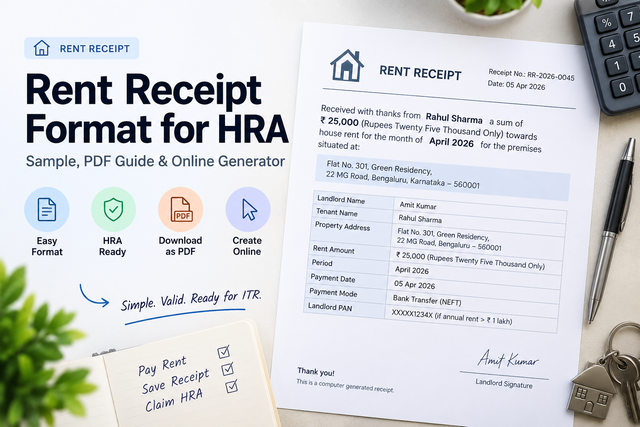
A rent receipt is a written acknowledgement that rent has been paid by a tenant to a landlord for a particular period. It usually records the rent amount, rental period, property address, landlord details, tenant details, payment date, and signature.
Rent receipts are also commonly maintained by salaried employees as supporting records when claiming House Rent Allowance (HRA). Keeping accurate receipts along with your rental agreement and payment records makes it easier to support the rent you actually paid.
If you need to create one, you can use the BillGenerator Rent Receipt Generator to enter the rental details and generate a printable PDF.
A useful rent receipt should generally contain:
- Tenant or employee name
- Landlord name
- Full address of the rented property
- Rent amount
- Month or period for which rent was paid
- Date of payment
- Payment method, such as bank transfer, UPI, cheque, or cash
- Landlord signature where required
- Landlord PAN or other supporting details where applicable
The information on the receipt should match the actual rental arrangement and payment records. Avoid using estimated or incorrect amounts simply to complete the document.
A simple rent receipt can look like this:
Rent Receipt
Received Rs 25,000 from Rahul Sharma towards house rent for April 2026 for the property located at:
22 MG Road, Bengaluru, Karnataka - 560001
Landlord Name: Amit Kumar
Payment Method: Bank Transfer
Payment Date: 5 April 2026
Landlord PAN: XXXXX1234X
Landlord Signature: __________
You can customise the format depending on your rental arrangement, employer requirements, and the information you need to maintain for your records.
Step 1: Enter tenant details
Add the tenant or employee name and the address of the rented property.
Step 2: Add landlord details
Enter the landlord name and other relevant information such as PAN where applicable.
Step 3: Select the rent period
Choose the month or period covered by the receipt and enter the amount actually paid.
Step 4: Add payment information
Mention the payment date and payment method so the receipt can be matched with your bank, UPI, cheque, or other payment records.
Step 5: Review and generate the PDF
Check every field before generating the receipt. You can then save or print the PDF for your records.
BillGenerator also supports creating rent receipts for multiple periods, which can be useful when maintaining month-wise documentation.
House rent receipts can be useful supporting records when HRA-related information is submitted to an employer or used while preparing an income-tax return.
Income-tax returns are generally filed without attaching supporting documents, but taxpayers should retain relevant records in case they are required later. These may include rent receipts, the rental agreement, bank statements, and other payment evidence.
Employer documentation requirements can differ, so check the requirements communicated by your payroll or HR team before submitting HRA proofs.
Monthly receipts make it easier to keep a clear record of when each payment was made and how much was paid. They are particularly useful when:
- Rent changes during the year
- The tenant changes the payment method
- There are gaps in the rental period
- An employer requests month-wise documentation
- Multiple properties or landlords are involved during the year
An annual summary may still be useful for your own records, but it should accurately reflect the underlying monthly payments.
Some rent receipts, particularly those involving cash payments, may include a revenue stamp and the landlord's signature depending on the documentation requirements applicable to the transaction.
If your employer or another organisation specifically asks for a stamped rent receipt, confirm the requirement before preparing the document.
For digital payments, it is also useful to retain the corresponding bank, UPI, or payment record together with the rent receipt.
- Entering a rent amount that does not match the actual payment
- Using the wrong rental period
- Misspelling the landlord or tenant name
- Using a property address different from the rental agreement
- Forgetting to retain payment evidence
- Adding tax or PAN information without checking whether it is applicable
- Generating receipts for transactions that did not actually occur
A rent receipt should document a genuine rental payment. Review the completed receipt before using it for payroll, tax, reimbursement, or record-keeping purposes.
Can I create a rent receipt online?
Yes. You can enter the tenant, landlord, property, rental period, and payment information and generate a PDF using an online rent receipt generator.
Do I upload rent receipts while filing ITR?
Income-tax returns are generally filed without attaching supporting documents. However, you should retain relevant rent receipts and supporting records in case they are required later.
Is a rent receipt the same as a rental agreement?
No. A rental agreement records the terms of the tenancy, while a rent receipt acknowledges a particular rent payment.
Can I generate receipts for multiple months?
Yes. If you have genuinely paid rent for those periods, you can maintain separate month-wise receipts or use a tool that supports generating multiple receipts.
Should I keep payment proof with the rent receipt?
Yes. Keeping bank, UPI, cheque, or other payment records alongside the receipt can make your rental records easier to verify.
A good rent receipt is simple: clearly record who paid the rent, who received it, the property address, the amount, the rental period, and the payment details.
Instead of creating the document manually each month, use the BillGenerator Rent Receipt Generator to create consistent rent receipts and export them as PDF files.
Generate your rent receipt at: https://portal.billgenerator.in/rent-receipt