Medical Bill Format: Free Hospital & Clinic Bill Templates
 Bill Generator Team
What is a medical bill?
A medical bill records genuine healthcare services and the amounts charged for them. A hospital, clinic or authorised provider can use it to show the patient, treating practitioner, services such as consultation, tests or procedures, payment details and the final amount. Patients may need these records for insurance, employer reimbursement or their own accounts.
Most qualifying healthcare services are exempt from GST, although some supplies — including certain hospital room charges and separately supplied medicines — can have different GST treatment.
Download medical bill templates
- Editable Word template (.docx)
- Excel medical expense register (.xlsx)
- Filled sample PDF — SAMPLE / DEMO (.pdf)
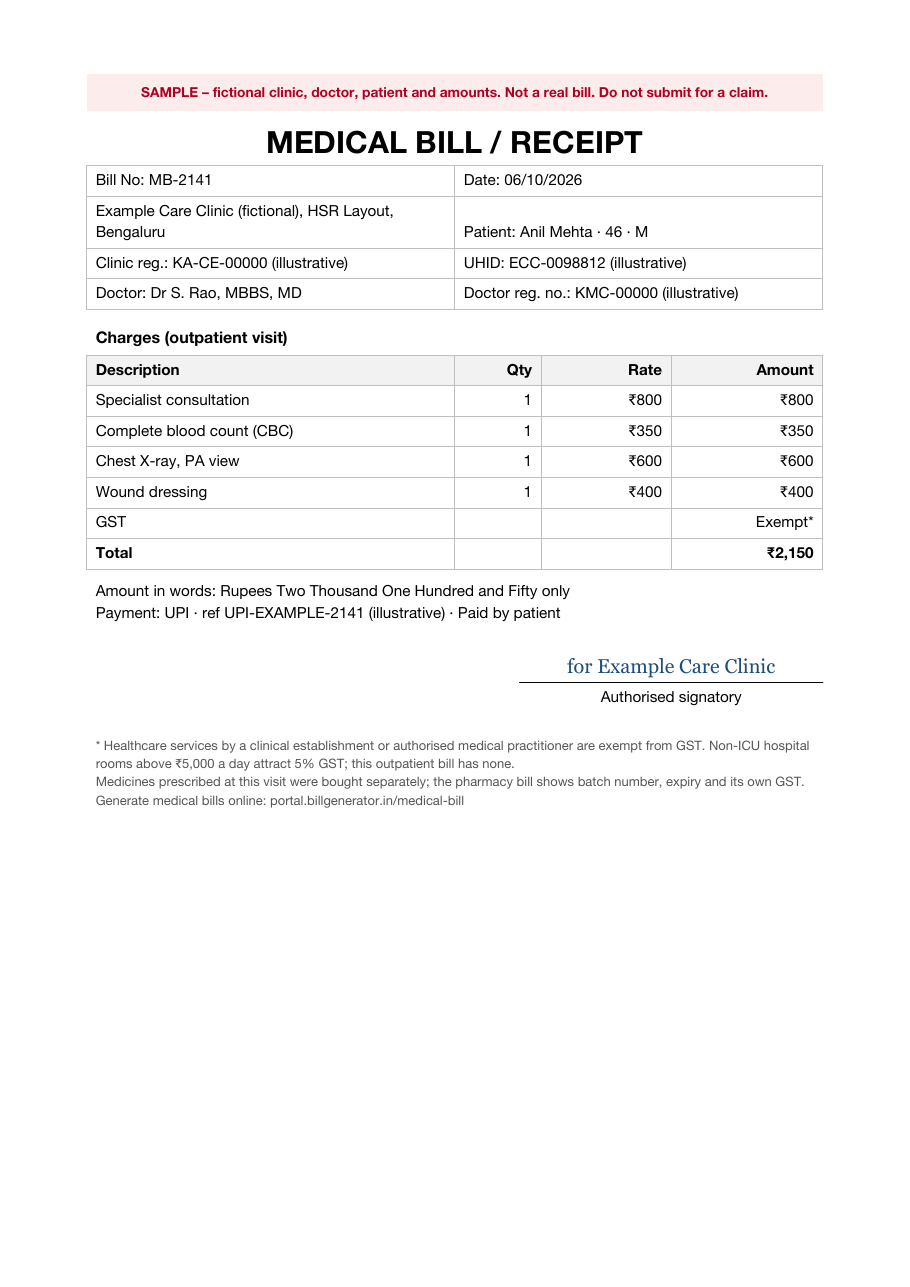
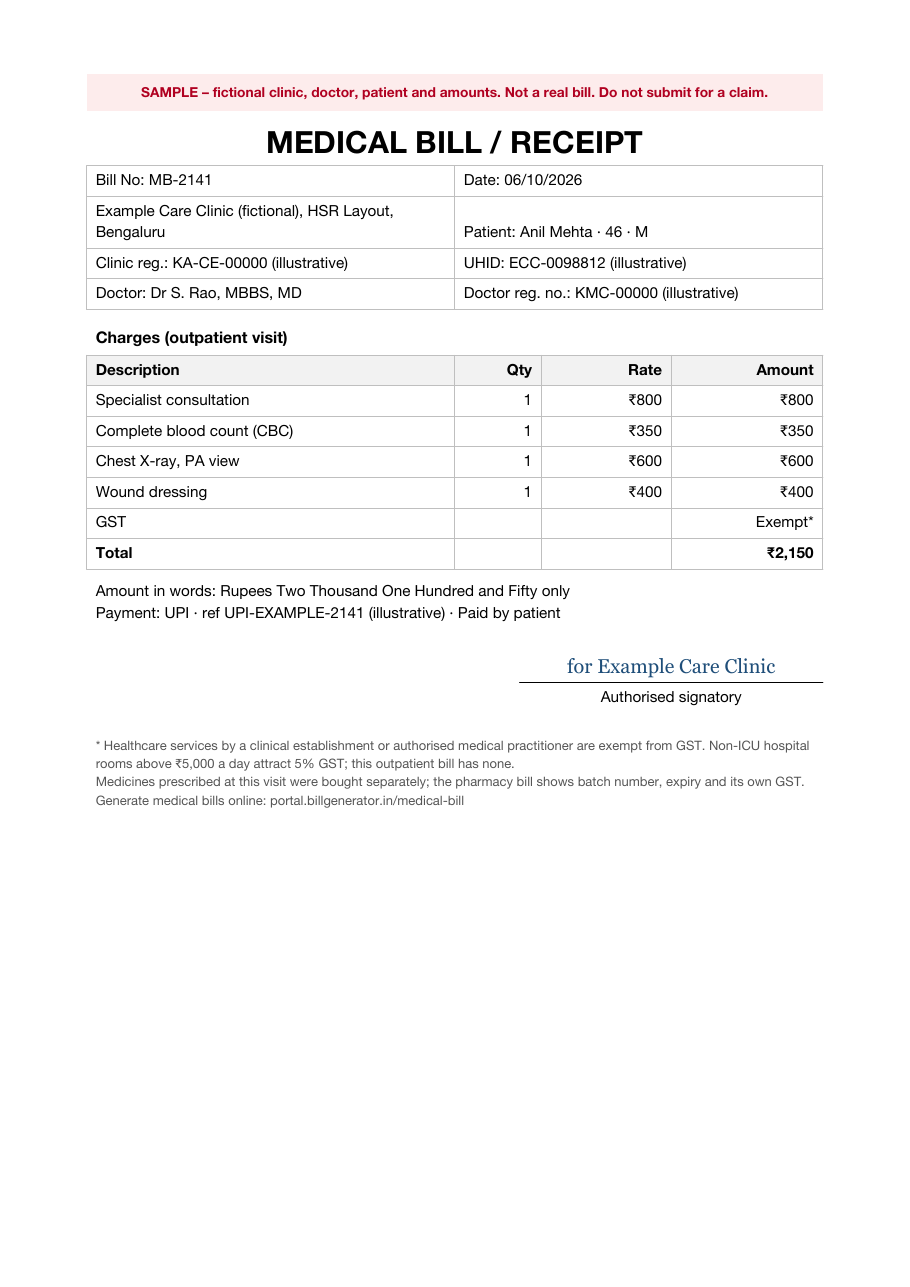
The filled PDF and sample image use a fictional clinic, doctor and patient and should be visibly marked SAMPLE / DEMO — NOT VALID FOR CLAIMS.
What a medical bill should include
The exact fields depend on the provider, type of treatment and the documents required by an insurer or employer.
Hospital or clinic
- Provider's genuine name, address and contact details
- Clinical-establishment or other registration number where applicable
- GSTIN where the provider is registered and the document contains taxable supplies
- Bill or receipt number and date
Patient and practitioner
- Patient's actual name and relevant identifying details
- Patient ID or UHID where the provider uses one
- Treating doctor's or practitioner's name and designation
- Medical council registration number where recorded or required
- Admission and discharge dates for an inpatient stay
Charges and payment
- Services listed separately, such as consultation, tests, procedures, room or nursing
- Medicines and consumables shown separately where charged
- Discounts, advances or insurer payments where applicable
- Amount payable by or received from the patient
- Payment method and reference where available
Field-by-field
| Field | What to enter | Why it matters |
|---|---|---|
| Bill number | Provider's genuine bill reference | Identifies the transaction and helps prevent duplicates |
| Patient ID / UHID | Provider's patient reference, where used | Connects the bill to the correct medical record |
| Practitioner | Actual treating doctor or practitioner | Identifies who provided or supervised the treatment |
| Itemised charges | Each material service or charge separately | Helps the patient, insurer or employer understand the total |
| Admission and discharge | Actual inpatient dates, if relevant | Explains room and hospitalisation charges |
| Amount payable / paid | Final amount after applicable adjustments | Shows the financial amount attributable to the patient |
| Payment reference | UPI, card, cheque or bank reference where available | Helps reconcile the document with payment evidence |
Medical bill format example
Consider a fictional outpatient visit to Example Care Clinic in Bengaluru, paid by UPI:
| Item | Qty | Rate | Amount |
|---|---|---|---|
| Specialist consultation | 1 | ₹800 | ₹800 |
| Complete blood count (CBC) | 1 | ₹350 | ₹350 |
| Chest X-ray, PA view | 1 | ₹600 | ₹600 |
| Wound dressing | 1 | ₹400 | ₹400 |
| GST on qualifying healthcare services | Exempt | ||
| Total | ₹2,150 |
This example assumes that the listed consultation, diagnostic and treatment services qualify as exempt healthcare services supplied by an eligible provider. It does not assume that every item sold by a hospital or clinic is GST-exempt.
The sample can also show the provider's registration information, patient reference and practitioner details. Any medicines purchased separately should be supported by the genuine pharmacy or provider document. All names and identifiers in the sample are fictional, and the completed example should remain marked SAMPLE / DEMO — NOT VALID FOR CLAIMS.
Download the medical bill template
The Word medical bill template is a blank editable A4 layout for provider, patient, practitioner, itemised charges, payment and other relevant details. Adapt the fields to the actual service provided rather than entering information that does not apply.
The Excel medical expense register is designed for patients or families tracking genuine medical expenses over the year. It can record the patient, provider, expense type, bill amount, claim status, settlement and outstanding amount.
The filled sample PDF demonstrates one fictional outpatient bill. All three files download without signing in.
The blank templates are starting points. A hospital, clinic or practitioner should issue documents using its genuine identity, registrations, treatment records and applicable tax treatment.
GST on medical bills
Healthcare services are generally exempt
Under the current GST exemption schedule, healthcare services provided by a clinical establishment, an authorised medical practitioner or paramedics are exempt from GST. This covers qualifying services by way of diagnosis, treatment or care for illness, injury, deformity, abnormality or pregnancy in a recognised system of medicine.
See the CBIC GST services rate and exemption table.
This means qualifying consultation, diagnosis, treatment and related healthcare services normally do not attract GST merely because they appear on a hospital or clinic bill.
Non-ICU rooms above ₹5,000 per day
There is a specific exception for certain hospital accommodation. Since 18 July 2022, services provided by a clinical establishment by way of a room — other than ICU, CCU, ICCU or NICU — where the room charge exceeds ₹5,000 per day to a person receiving healthcare services are taxable at 5% GST without input tax credit.
The rate was introduced by Notification No. 03/2022-Central Tax (Rate), while Notification No. 04/2022-Central Tax (Rate) amended the healthcare exemption accordingly.
A room charged at exactly ₹5,000 per day does not cross the 'exceeding ₹5,000' threshold in this entry. ICU, CCU, ICCU and NICU rooms are specifically excluded from this taxable-room entry.
Medicines and pharmacy supplies
Medicines are goods and have their own GST classification. With effect from 22 September 2025, the GST Council reforms reduced the general rate on other drugs and medicines from 12% to 5%, while 33 specified lifesaving drugs and medicines moved from 12% to Nil and another 3 moved from 5% to Nil.
See the Finance Ministry's 56th GST Council recommendations and its medicine-rate FAQ.
Therefore, do not simply mark every medicine line as either exempt or 5%. The applicable treatment depends on the particular medicine and how the supply is structured. A retail pharmacy bill should use the GST classification and rate applicable to the medicine actually sold.
Healthcare providers should confirm their GST position for taxable supplies rather than relying on a template's default tax field.
Medical bill vs pharmacy bill vs discharge summary
- Medical or hospital bill: records healthcare services and other charges billed by a clinic, hospital or practitioner.
- Pharmacy bill: records medicines or other products sold by a pharmacy or dispensing provider. It should identify the actual products and applicable tax treatment; additional details such as batch or expiry information may appear depending on the system and regulatory requirements.
- Discharge summary: records the clinical course of an inpatient stay, including diagnosis, treatment and discharge information. It is a medical record, not a substitute for the final bill.
For a reimbursement or insurance claim, the documents required vary by insurer, employer and type of treatment. Keep the original itemised bills, payment receipts, prescriptions, reports and discharge documents that apply to the actual claim.
How to create a medical bill online
- Open the medical bill generator and choose one of the available templates.
- Enter the genuine hospital or clinic information and practitioner details.
- Add the real patient information, including the relevant patient or registration details available for the selected template.
- Enter each genuine consultation, procedure, test, room or other charge separately in the bill summary.
- Add payment information and enter tax only where it applies to the actual supply.
- Review the live preview carefully, sign in and generate the PDF.
The generator's fields can differ by template. Use only the details supported by the provider's actual treatment and records.
Why use a reusable medical bill template?
A reusable layout helps a clinic or practitioner record the same core details consistently while still itemising each patient's actual treatment. Clear line items also make it easier for patients to understand a charge and for an insurer or employer to review the documents it requires.
A separate expense register can help patients track which genuine bills have been submitted, settled or remain outstanding. It should be used as an organisational record rather than as a substitute for provider-issued medical documents.
Medical bill PDF: what to check before you save
Before exporting or submitting a medical bill PDF, check that:
- Patient details match the provider's treatment record
- Provider and practitioner details are correct
- Each material service or charge is listed clearly
- Admission and discharge dates are correct for an inpatient stay
- GST is applied only to supplies that are actually taxable
- Any taxable non-ICU room above ₹5,000 per day is treated correctly
- The bill total reconciles with discounts, advances, insurer payments and the amount paid
- Payment details match the genuine transaction where recorded
Open the finished PDF itself before issuing or submitting it.
Genuine treatment and provider identity
Use these templates only for treatment and healthcare transactions that actually occurred and that you are authorised to document.
Do not copy a hospital's or clinic's name, logo, registration number or GSTIN, or a doctor's name or registration number, onto a document that provider did not issue. Do not invent treatment, patients, dates or charges, and do not inflate genuine medical expenses.
If you are a patient who has lost a bill, ask the hospital, clinic, practitioner or pharmacy for a duplicate or replacement from its records. The fictional sample on this page exists only to explain the layout and must not be submitted as evidence of actual treatment or payment.
Common medical bill mistakes
- Only showing a lump-sum total. Itemised charges make the bill easier to understand and review.
- Incorrect provider or practitioner information. Use the actual details from the treatment record.
- Patient details do not match the medical record. Correct genuine errors through the provider rather than altering another document.
- GST added to exempt healthcare services. Qualifying healthcare services are generally exempt.
- Assuming every hospital charge has the same GST treatment. Certain room charges and separately supplied goods can be treated differently.
- Using a recreated bill for lost evidence. Request a duplicate from the actual provider instead.
Frequently asked questions
What is the format of a medical bill?
A useful medical bill identifies the genuine hospital, clinic or practitioner, the patient, the bill date and reference, and the services or other charges supplied. It normally shows itemised amounts, adjustments, the final total and payment information where applicable. Additional fields depend on the treatment and provider.
Is GST charged on hospital bills?
Qualifying healthcare services by clinical establishments, authorised medical practitioners and paramedics are generally GST-exempt. One important exception is a non-ICU/CCU/ICCU/NICU hospital room charged at more than ₹5,000 per day, which attracts 5% GST without ITC. Separately supplied medicines and other goods follow their own GST classifications.
Can I download a medical bill format in Word?
Yes. The Word template is free to download without signing in. The page also provides an Excel medical expense register and a fictional sample PDF.
What documents may be needed with a medical insurance claim?
Requirements vary by policy and insurer. Common documents can include the claim form, final itemised bills, payment receipts, prescriptions, investigation reports, pharmacy bills and, for hospitalisation, the discharge summary. Always check the insurer's current claim checklist for the specific policy.
What is the difference between a medical bill and a pharmacy bill?
A medical bill primarily records healthcare services and associated provider charges. A pharmacy bill records medicines or other products supplied. Their GST treatment can differ, so medicine lines should use the classification and rate applicable to the actual product rather than automatically following the healthcare-service exemption.
What should I do if I lose a hospital bill?
Ask the hospital or clinic for a duplicate or certified replacement from its records. Do not recreate the provider's identity, registration details or charges yourself and submit the recreation as though the provider issued it.
Generate a medical bill online
Hospitals, clinics and authorised practitioners can use the medical bill generator to prepare clear, itemised bills for genuine treatment they are authorised to document. Enter the actual provider, patient, treatment and payment information, review the preview and generate the PDF.
For other genuine reimbursement records, see the rent receipt format for HRA and the cab bill format. For other document types, see the bills and receipts hub.